
Fibre optic extension
WHAT ARE GLASS FIBRES?
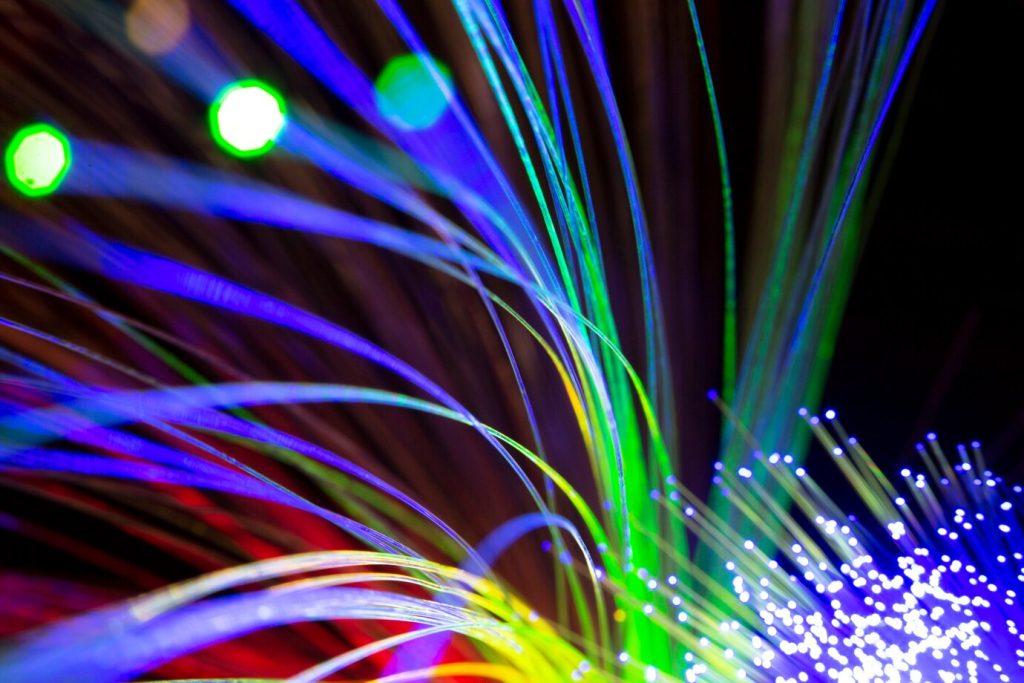
Glass fibres are very thin strands of pure glass or quartz that are used to transmit light. They have a very high refractive index, which means that the light that is transmitted through them remains well focused and does not scatter as much as other materials. This means that signals can be transmitted over longer distances and with a wider bandwidth than conventional copper wires. They are mainly used in telecommunications and on the internet. They are also used in medicine, lighting and industrial automation. Glass fibres are robust, do not conduct heat or electricity and are immune to electromagnetic interference.
HOW TO INSTALL FIBER OPTIC CABLES?
There are several methods of laying fibre optic cables, depending on the type of environment and requirements. Here are some of the most common methods:
Ingrounding: This is the most common method of laying fibre optic cables. The cables are laid in a prepared trench and covered with soil. For example, using a cable plough or micro-slots (minimal digging using a cutter). This method is particularly suitable for rural areas and areas where there is no existing infrastructure.
Antenna installation: This method is particularly suitable for areas where it is difficult to install underground cables, for example in urban areas with a lot of existing infrastructure. Cables are attached either to poles or to existing buildings.
Installation through cable ducts: This method is particularly suitable for areas where there is a solid existing infrastructure. Cables are laid in existing cable ducts to protect them from damage and environmental influences.
Underwater installation: This method is used to install cables underwater, for example under rivers or oceans. This requires specialised equipment and skills to ensure that the cables are properly positioned to avoid damage.
Drilling methods: In some cases, when it is not possible to lay pipes by excavation or overhead installation, the installation of pipes can be done by horizontal drilling method. Our company uses the most modern and efficient method, the directional drilling method.
There are also combinations of these methods, depending on the requirements. Each method has its own challenges and requires specialised skills and tools to ensure that pipes are laid properly and that no damage is caused.
WHY FIBER OPTICS?
In the future, fibre optic cables are expected to be used in a variety of areas. Some examples include the following:
Broadband Internet: Demand for fast, reliable internet continues to grow, and fiber optic lines offer greater bandwidth than traditional copper wires, allowing more people to stream high-definition content and download data faster at the same time.
Internet of Things (IoT): More and more devices are becoming connected and require more bandwidth and less delay. Fibre optic cables can meet these requirements and allow IoT devices to communicate with each other faster and more reliably.
5G/6G: Deployment of 5G networks will require even higher bandwidth and lower latency, and fibre-optic lines will play an important role in supporting this technology.
Smart cities: As smart cities develop, more and more sensors will be installed and devices will be used to collect and process data. Fibre optic cables will make it possible to transmit and process this data faster and more reliably.
Automation and artificial intelligence: In the field of industrial automation and artificial intelligence, ever-increasing amounts of data are being processed and transmitted, requiring greater bandwidth and ever-shrinking delays. Fibre optic cables make it possible to meet these requirements.
These are just a few examples, but there are many other applications where fibre optic cables can be used in the future.
ARE THERE ANY DISADVANTAGES TO FIBRE OPTIC CABLES?
Yes, there are some disadvantages to using fibre optic cables. Among these we can list the following:
The cost: fibre optic cables are more expensive to install than traditional copper wire connections. This is due to the higher cost of materials and specialised equipment required.
Difficulty of installation: Installing fibre optic cables is more complex and difficult than installing copper wires. Specialised skills and tools are needed to lay the cables correctly so that no damage is caused. Our company provides such services.
Sensitivity: fiber optic cables are very sensitive to damage and can be easily damaged if not installed properly. Once damaged, repairs are difficult and costly.
Availability: In some areas, the availability of fibre-optic lines is still limited. There are still many areas, especially in rural areas, where the installation of fibre-optic lines is not yet possible.
Compatibility issues: Fibre optic lines require special equipment and devices to transmit signals and there may be compatibility issues with existing systems.
Despite these disadvantages, the advantages of fibre optic lines are overwhelming, especially given the demands expected of modern and future technology. The widespread availability and reduced cost of this technology will reduce the disadvantages in the coming period.